
Aquarium Care Guide: Filtration, Water Quality, and Fish Behavior
A complete aquarium care guide covering filtration maintenance, water parameters, tank size, temperature stability, and aggression control for healthy fish.

By Fishmetry Team
5 min read
Published at Jan 20, 2026, 12:37 AM
Reviewed for accuracy · Last updated Jan 20, 2026, 12:51 AM
A healthy aquarium is built on consistency, observation, and respect for aquatic life. Many problems faced by beginner and intermediate aquarists—such as stressed fish, unstable water, or unexplained losses—are usually caused by basic maintenance and environmental mistakes. This guide clearly separates the key topics every aquarist should understand to maintain a stable and ethical aquarium.
PWC: The Foundation of Aquarium Stability
In aquarism, PWC means Partial Water Change. It is one of the most essential practices in responsible fishkeeping and cannot be replaced by filtration alone.
A Partial Water Change consists of removing a portion of aquarium water (typically 10–40%) and replacing it with clean, treated water of similar temperature and parameters.
Most long-term aquarium problems stem from neglected, inconsistent, or improperly executed partial water changes.
Why Partial Water Changes Matter
Partial Water Changes perform several critical functions:
- Dilute accumulated toxins such as nitrates and dissolved organic waste
- Replenish essential minerals and trace elements
- Stabilize water chemistry over time
- Improve oxygenation and overall water quality
Unlike large or full water changes, PWCs correct water quality gradually while preserving beneficial bacteria and biological stability.
How Often PWCs Should Be Done
There is no universal rule, but common guidelines include:
- Lightly stocked aquariums: 10–20% weekly
- Moderately stocked aquariums: 20–30% weekly
- Heavily stocked or grow-out tanks: 30–40% weekly
Consistency is more important than volume. Small, regular changes are safer than large, infrequent ones.
Common PWC Mistakes to Avoid
- Skipping water changes because the water looks clear
- Performing large changes without matching temperature
- Forgetting dechlorinator when using tap water
- Over-vacuuming and disrupting substrate biology
Clear water does not mean clean water.
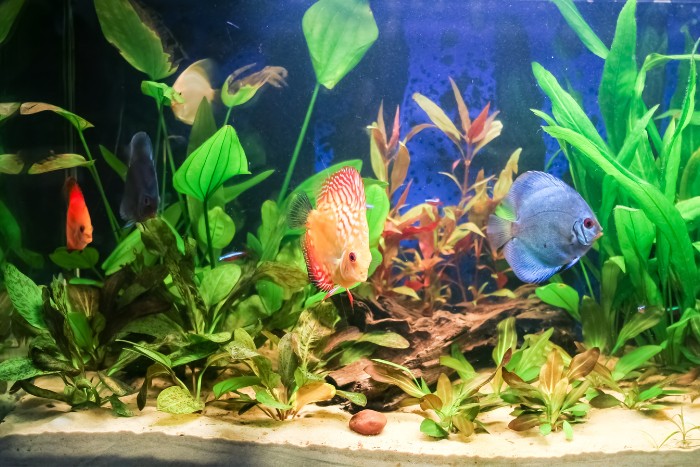
Disco fish in a home aquarium
Cleaning and Maintaining a Hang-On-Back (HOB) Filter
Hang-on-back filters are widely used, but incorrect cleaning can disrupt biological balance.
Proper Cleaning Guidelines
- Rinse filter media in old aquarium water
- Never use soap or untreated tap water
- Clean only when water flow is reduced
Preserving beneficial bacteria is more important than making the filter look clean.
What to Clean
- Mechanical sponge or floss: light rinse only
- Impeller and intake tube: monthly inspection and cleaning
- Biological media: disturb as little as possible
Changing Filter Media Safely
Replacing filter media incorrectly can cause ammonia and nitrite spikes.
Never replace all filter media at the same time.
Best Practices
- Replace only damaged or deteriorated mechanical media
- Stagger replacements over several weeks
- Prefer reusable sponges and ceramic biological media
Stable filtration supports long-term aquarium health.
Watching Temperature During Extreme Seasons
Fish rely entirely on water temperature to regulate their bodies.
Winter Risks
- Heater malfunction
- Sudden nighttime temperature drops
Summer Risks
- Overheating
- Reduced oxygen levels
| Season | Main Risk | Prevention |
|---|---|---|
| Winter | Heater failure | Daily temperature checks |
| Summer | Overheating | Ventilation and increased aeration |
Sudden temperature changes are more harmful than slightly imperfect temperatures.

A stable planted aquarium
Importance of an Adequate Aquarium Size
Tank size directly affects water stability and fish behavior.
Why Size Matters
- Waste accumulates faster in small volumes
- Aggression increases with limited space
- Temperature and pH fluctuate more easily
Always research adult fish size before choosing a tank.
How pH and GH Influence Fish Health
Water chemistry plays a critical role in long-term fish well-being.
pH
- Influences stress levels and immune response
- Rapid changes can cause physiological shock
GH (General Hardness)
- Affects osmoregulation and mineral balance
- Important for bone development and breeding
Stable parameters are safer than frequent adjustments.
| Parameter | Primary Effect | Importance |
|---|---|---|
| pH | Stress control | Immune health |
| GH | Mineral balance | Growth and vitality |
Understanding Fish Aggression
Aggression is usually caused by environmental conditions rather than inherent temperament.
Common Causes
- Overcrowding
- Incompatible species
- Lack of hiding places or territory
Prevention
- Choose compatible species
- Provide plants, caves, and visual barriers
- Avoid mixing territorial fish in small tanks
Early signs include fin damage, constant chasing, and prolonged hiding.
Final Thoughts on Responsible Fishkeeping
Successful aquariums depend on consistent partial water changes, stable filtration, controlled temperature, adequate space, and informed stocking choices. When these fundamentals are respected, aquariums become stable ecosystems rather than fragile systems.
Responsible aquarism prioritizes prevention, consistency, and animal welfare above all else.