
Hard
Silver Moony
Monodactylus argenteus
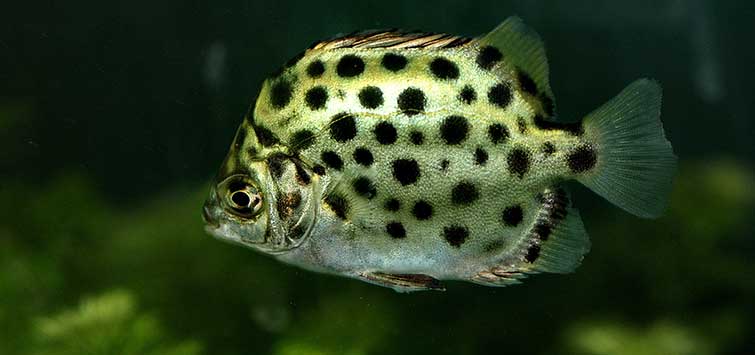
Scatophagus argus
Reviewed for accuracy · Last updated Jan 10, 2026, 4:26 PM
Active, social brackish-water fish that can be boisterous, curious, and occasionally nippy when crowded.
Brackish
Moderate
Medium
106 gal (400 L)
12 in (30 cm)
10–15 years
Omnivore
Euryhaline
Choosing suitable tank mates for Scatophagus argus requires careful consideration of size, temperament, and salinity tolerance.
Spotted scats are generally social and do best in groups, but they are also assertive feeders and can outcompete slower or smaller fish. Tank mates must be robust enough to handle their energetic behavior and capable of living in brackish water conditions.
Good companions include other medium to large brackish species such as monos, archerfish, larger gobies, and brackish-tolerant puffers that are not overly aggressive. These species share similar environmental requirements and feeding behaviors, reducing stress and competition.
Avoid small, delicate, or very passive fish, as they may be harassed or outcompeted for food. Fin-nipping can occur, especially in cramped conditions or when scats are underfed. Similarly, highly aggressive species may provoke constant conflict.
Stocking density should be conservative. Overcrowding increases stress and aggression, even among compatible species. Providing visual barriers and open space helps establish loose territories without trapping weaker individuals.
In large, well-maintained brackish community tanks, spotted scats can coexist peacefully and display engaging social behavior. Long-term success depends on matching adult sizes and maintaining stable water parameters for all inhabitants.
Monodactylus argenteus
Scatophagus argus is a large, robust brackish-water fish that requires spacious aquariums and stable water conditions to thrive long term.
In the wild, this species inhabits estuaries, mangroves, and coastal river mouths where salinity fluctuates with tides. Replicating this environment in captivity means maintaining slightly brackish water with consistent specific gravity, avoiding sudden changes. Juveniles may tolerate freshwater for short periods, but adults require brackish conditions to remain healthy.
Tank size is critical. Although often sold as small juveniles, spotted scats grow quickly and develop deep, disc-shaped bodies. A large aquarium with ample horizontal swimming space is mandatory, along with strong filtration capable of handling heavy waste production. These fish are messy eaters and produce significant bioload.
Decor should emphasize open swimming areas combined with sturdy décor such as driftwood, rocks, and mangrove-style roots. Live plants are often damaged or eaten, so hardy brackish-tolerant species or artificial plants are recommended. Substrate can be sand or fine gravel, which mimics their natural habitat and allows natural foraging behavior.
Stable temperature, proper salinity, and high oxygenation are essential. Powerheads or strong filter outflow help replicate tidal currents. Regular water changes are necessary to prevent nitrate buildup, as scats are sensitive to poor water quality despite their hardy appearance.
Overall, Scatophagus argus is best suited for experienced aquarists who can provide large tanks, brackish water expertise, and long-term planning for adult size and social needs.
Scatophagus argus is an opportunistic omnivore with a strong preference for plant-based foods supplemented by animal matter.
In nature, this species feeds on algae, detritus, plant material, small invertebrates, and organic debris found in estuarine environments. This diverse diet should be replicated in captivity to ensure proper growth, coloration, and immune health.
A high-quality omnivore pellet or flake formulated for brackish or marine fish should form the dietary base. Regular supplementation with blanched vegetables such as spinach, zucchini, peas, and lettuce is highly recommended, as scats have a strong grazing instinct.
Protein sources should be offered in moderation and can include frozen or live foods such as bloodworms, brine shrimp, mysis shrimp, and finely chopped seafood. Excessive protein without sufficient vegetable matter can lead to digestive issues and fatty degeneration.
Feeding should occur once or twice daily, offering portions that are consumed within a few minutes. Because scats are aggressive feeders, spreading food across the tank helps ensure all individuals receive adequate nutrition.
Consistent dietary variety is essential. A balanced feeding routine not only supports physical health but also reduces boredom-related aggression, making diet management a key aspect of successful long-term care.
Breeding Scatophagus argus in captivity is extremely rare and not considered feasible for most home aquarists.
In the wild, this species is believed to migrate between brackish and marine environments for spawning, possibly releasing eggs in higher salinity coastal waters. The exact triggers for breeding include seasonal changes, salinity shifts, and environmental cues that are difficult to replicate in aquariums.
Sexual dimorphism is minimal, making it hard to distinguish males from females without invasive examination. Even when mature pairs are present, spawning behavior is seldom observed in captivity.
Eggs and larvae, if produced, would require marine or near-marine conditions, specialized live foods, and precise water quality management. The larval stage is presumed to be highly sensitive, with significant mortality outside natural conditions.
As a result, all specimens available in the aquarium trade are wild-caught or produced in large-scale commercial operations with access to controlled coastal facilities.
For aquarists, breeding should not be a goal when keeping spotted scats. Instead, focus should be placed on long-term care, proper environment, and maintaining healthy adult specimens that display natural behavior and coloration.
Some links on this page may earn Fishmetry a commission at no extra cost to you.